 how-to
How to Assess Yarn Quality Online: A 2026 Guide
Table of Contents
- A Practical Checklist for Assessing Yarn Quality Online
- Starting With the Product Description and Specifications
- How to Read a Yarn Label: Fibre Content, Origin and Care
- Your Yarn Weight and Ply Guide for Online Shopping
- How to Tell If Yarn Is Good Quality From Photos and Specs
- Questions to Ask a Yarn Seller Before You Buy
- Swatch Testing and Value Beyond Price Per Skein
- Frequently Asked Questions
Last Updated: October 8, 2026
A Practical Checklist for Assessing Yarn Quality Online
Learning how to assess yarn quality online comes down to one habit: read the listing like a spec sheet, not a sales pitch. This guide from Hooked on Molong walks you through exactly what to check, in order, before you add anything to your cart.
Buying yarn you cannot touch is the hardest part of shopping online. You miss the squeeze test. You miss holding a skein to the light. So we built a checklist that replaces your hands with your eyes.
Here is the short version:
- Read the fibre content and origin
- Check the weight, ply and recommended needle size
- Compare yardage against skein weight
Work through that list and most bad purchases never happen. Below, we break down each step in detail.
Starting With the Product Description and Specifications
A good product description tells you fibre content, weight, yardage, skein weight, colour and care in plain terms. If a listing hides those details, treat it as a warning sign.
Product specifications are the backbone of any online yarn assessment. The Australian Competition and Consumer Commission guide to online shopping notes that businesses must describe products accurately, so a vague listing is a real problem, not just an annoyance.
Here is what a complete listing should state:
- Fibre content, with percentages for blends
- Yarn weight category and recommended needle or hook size
- Yardage or metres per skein, plus skein weight in grams
If even two of those are missing, message the seller before buying. A shop that sources specific items for customers will happily fill in the gaps.
How to Read a Yarn Label: Fibre Content, Origin and Care
A yarn label is your fastest quality check. It lists fibre content, fibre origin, weight, yardage, colour, dye lot and care advice, all in one place.
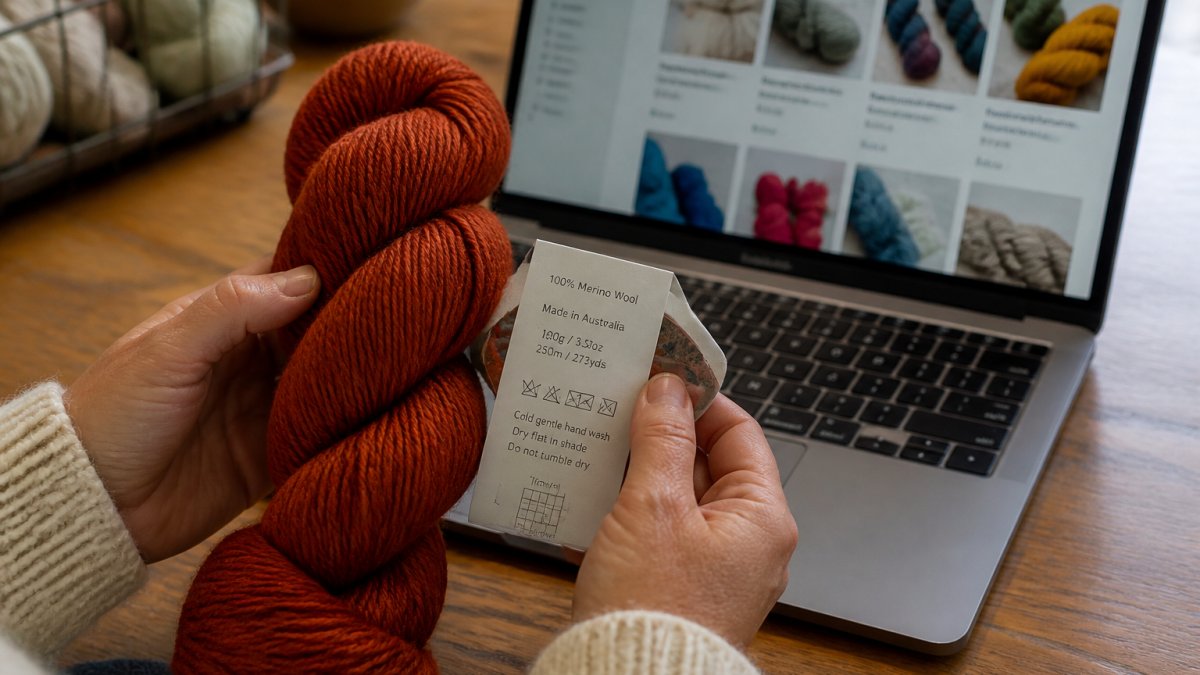
Fibre content tells you how the yarn will behave. Natural fibres like wool, cotton and alpaca breathe and hold shape.
Fibre origin matters too. The International Wool Textile Organisation explains how wool fibre properties vary by source, which is why two merino yarns can feel quite different.
Care instructions decide how a finished garment lives. Check whether the yarn is machine washable or hand wash only.
Your Yarn Weight and Ply Guide for Online Shopping
Yarn weight describes the thickness of the strand, not how heavy the skein is. Ply describes how many strands are twisted together to make it.
This trips up almost every new shopper. A "worsted" yarn and a "10-ply" yarn are different measurements, and a bulky yarn can still be light in the hand.
Use this quick reference:
| Weight Category | Common Ply | Approx. Metres per 100 g | Suggested Needle (mm) | Best For |
|---|---|---|---|---|
| Lace | 2-ply | 600-900 m | 1.5-2.5 mm | Shawls, fine detail |
| Fingering | 4-ply | 350-450 m | 2.25-3.25 mm | Socks, baby wear |
| Sport | 5-ply | 270-350 m | 3.25-3.75 mm | Light garments |
| DK | 8-ply | 200-250 m | 3.75-4.5 mm | Sweaters, blankets |
| Worsted | 10-ply | 180-220 m | 4.5-5.5 mm | Hats, mittens |
| Bulky | 12-ply+ | 100-140 m | 6-9 mm | Quick knits, throws |
The metre-per-100-gram range is the number most shoppers ignore and most need. It tells you how far a skein will actually go.
Reading count, gauge and tension
Yarn count is a numerical system for the thickness of the strand.
Gauge is the number of stitches and rows per 10 cm that the manufacturer expects when the yarn is knitted on the recommended needle size. Tension is your own version of that number.
When you read a listing, look for the gauge statement. It usually appears as something like "22 stitches and 30 rows to 10 cm on 4 mm needles." That single line tells you:
- Whether the yarn is fine or chunky (stitch count)
- Whether it will drape or hold structure (row count relative to stitch count)
- Whether your usual needle size will work
If the listing gives no gauge, ask the seller. A yarn without a gauge recommendation is a yarn you cannot confidently substitute.
Why this matters for substitution
Always match the yarn weight to your pattern. Substituting a bulky yarn for a DK pattern will change the finished size, sometimes dramatically. A 10 cm difference in gauge across a 100 cm chest can add 15 cm or more to the finished garment.
A common pattern is to substitute by weight category alone and assume the gauge will follow. It often does not. Fibre content, twist and ply all shift the gauge.
If you are working from a pattern that specifies a yarn you cannot source, match the gauge first, the fibre second, and the weight category third. Gauge is the only number that directly controls fit.
How to Tell If Yarn Is Good Quality From Photos and Specs
You can judge a lot from listing photos if you know what to look for, but only if you treat the image as evidence rather than decoration. Good photos show the yarn in natural light, at close range, with the twist and texture visible. Poor photos hide the very things that tell you whether the yarn will pill, split or fade.
Here is a repeatable method for assessing a listing photo before you buy.
Step 1: Check the light source
Look at the shadows. If the skein casts a hard, dark shadow, the photo was taken under direct indoor light, which flattens texture and shifts colour warm. If the shadow is soft or absent, the photo was likely taken in daylight or with a diffused source, which is more reliable.
A common pattern is for sellers to photograph yarn on a white background under cool LED light. This makes pale yarns look brighter and warm yarns look duller than they are.
Step 2: Look for a scale reference
A photo with no scale reference tells you nothing about thickness. Look for a coin, a ruler, a hand or a common object next to the skein. If the seller has not provided one, ask. A reputable shop may photograph the actual skein you will receive, in daylight, next to a common object for scale.
Step 3: Study the twist and surface
Zoom in on the strand. You are looking for:
- Even twist along the length, no thick-and-thin variation unless the yarn is deliberately textured
- A clean surface with fibres lying flat, not haloing out
- No visible slubs, knots or thin spots
A fuzzy halo in the photo can mean the yarn is loosely spun and will pill. A tight, smooth surface usually means a firmer yarn that holds stitch definition. Neither is better in the abstract, it depends on the project.
Step 4: Compare multiple skeins in one photo
If the listing shows several skeins together, study them side by side. Dye lot variation shows up as subtle shifts in tone between skeins that look identical in isolation.
Dye lot consistency matters most for multi-skein projects. If the listing does not show a dye lot number, ask before you buy. Two skeins from different dye lots can clash, even in the same colour name.
Step 5: Account for your own screen
Online photos rarely capture colour perfectly. Screens vary, and lighting shifts tones. Treat the photo as a guide, not a guarantee. If colour accuracy is critical, for a colourwork project, for example, ask the seller for a photo taken in daylight next to a colour reference card or a common object with a known colour.
What the specs add that photos cannot
Photos show surface. Specs show behaviour. Cross-check the image against the written listing:
- Fibre content tells you how the yarn will wear, wash and drape
- Gauge tells you whether the thickness in the photo matches the pattern you have in mind
- Metres per 100 g tells you whether the skein is dense or airy
If the photo and the specs disagree, a fine-looking yarn with a bulky gauge, for example, trust the specs. Photos can be styled; numbers usually cannot.
Reviews help here. Look for customer reviews that mention colour accuracy, softness and how the yarn behaved in a real project. A review that says "darker than the photo" is more useful than a five-star rating with no detail.
Questions to Ask a Yarn Seller Before You Buy
A quick message before you buy saves returns later. Ask about fibre, weight, dye lot, stock levels and delivery time.
Here are the questions we recommend, in order of importance:
- Is this yarn in stock, and how many skeins are available?
- What dye lot are the skeins from?
- Can you confirm the yardage and skein weight?
- Is this suitable for a beginner project?
- How long does delivery take, and what is the return policy?
That last question matters for online buyers. The ACCC guidance on consumer guarantees explains your rights when a product does not match its description, so know them before you order.
If you are shopping for a complicated pattern, ask whether the seller can source specific yarns.
Swatch Testing and Value Beyond Price Per Skein
Swatch testing is the final quality check, and it happens after your yarn arrives. Knit or crochet a small square, wash it, and see how it behaves.
Here is what your swatch tells you:
- Whether the gauge matches your pattern
- How the yarn feels against your skin
- Whether the colour bleeds when washed
Value is more than price per skein. A cheap skein with short yardage can cost more per metre than a slightly pricier skein with generous length.
Consider these factors instead of sticker price alone:
- Metres per 100 grams
- Fibre quality and blend
- How far one skein stretches in your pattern
- Shipping costs and free shipping thresholds
We offer free shipping on orders over $150, which changes the maths on larger projects.
Frequently Asked Questions
How can you tell if yarn is good quality from an online listing?
Look for detailed fibre content, weight and ply information, and clear photos showing texture and twist. Check the product description for yardage, skein weight and care instructions. Reviews that mention consistency, softness and how the yarn behaved in finished projects give you real-world signals. A listing that answers these points is usually from a seller who knows their stock, which is a good sign for yarn quality.
What should you check in a yarn description before buying?
Start with fibre content and origin, then confirm the yarn weight and ply match your pattern. Check yardage and skein weight so you know how many balls you need. Look for dye lot information, care instructions and any certifications. If the listing includes project examples or gauge details, that helps you predict how the yarn will behave in knitting or crochet. Missing information is a reason to ask the seller directly.
How do you compare yarn fibres and construction online?
Compare natural fibres like wool and cotton with synthetic fibres and blends by reading the percentages in the fibre content. A higher ply and tighter twist usually mean better stitch definition and durability, while looser twist gives more softness and drape. Look for photos that show the yarn up close so you can judge texture. Reviews often reveal whether the yarn pills, splits or holds its shape after washing.
How can you judge yarn colour accurately from product photos?
Product photos can vary with lighting and screen settings, so treat them as a guide rather than an exact match. Look for listings that show the yarn in daylight and mention the dye lot. If colour accuracy matters for your project, ask the seller for a photo in natural light or check whether they offer samples. Reading reviews for comments on colour consistency also helps you avoid surprises when your order arrives.
Buying yarn online comes with real risk: you cannot touch it, and colour never looks the same on a screen. That is exactly why we built Hooked on Molong around personal help, not just a checkout page. We source yarns locally and from overseas suppliers, answer your questions before you buy, and track down specific fibres for tricky patterns. Subscribe to our newsletter for project ideas and new arrivals, or get in touch and we will help you pick the right yarn for your next make.